National Security
24 Hours of Code · Complete

Built trackside at Spa.

We arrived at CrowdStrike 24 Hours of Spa with laptops and embedded alongside the Greystone GT team. Over 48 hours, we turned garage conversations into a live race platform that engineers trusted while the race was running.

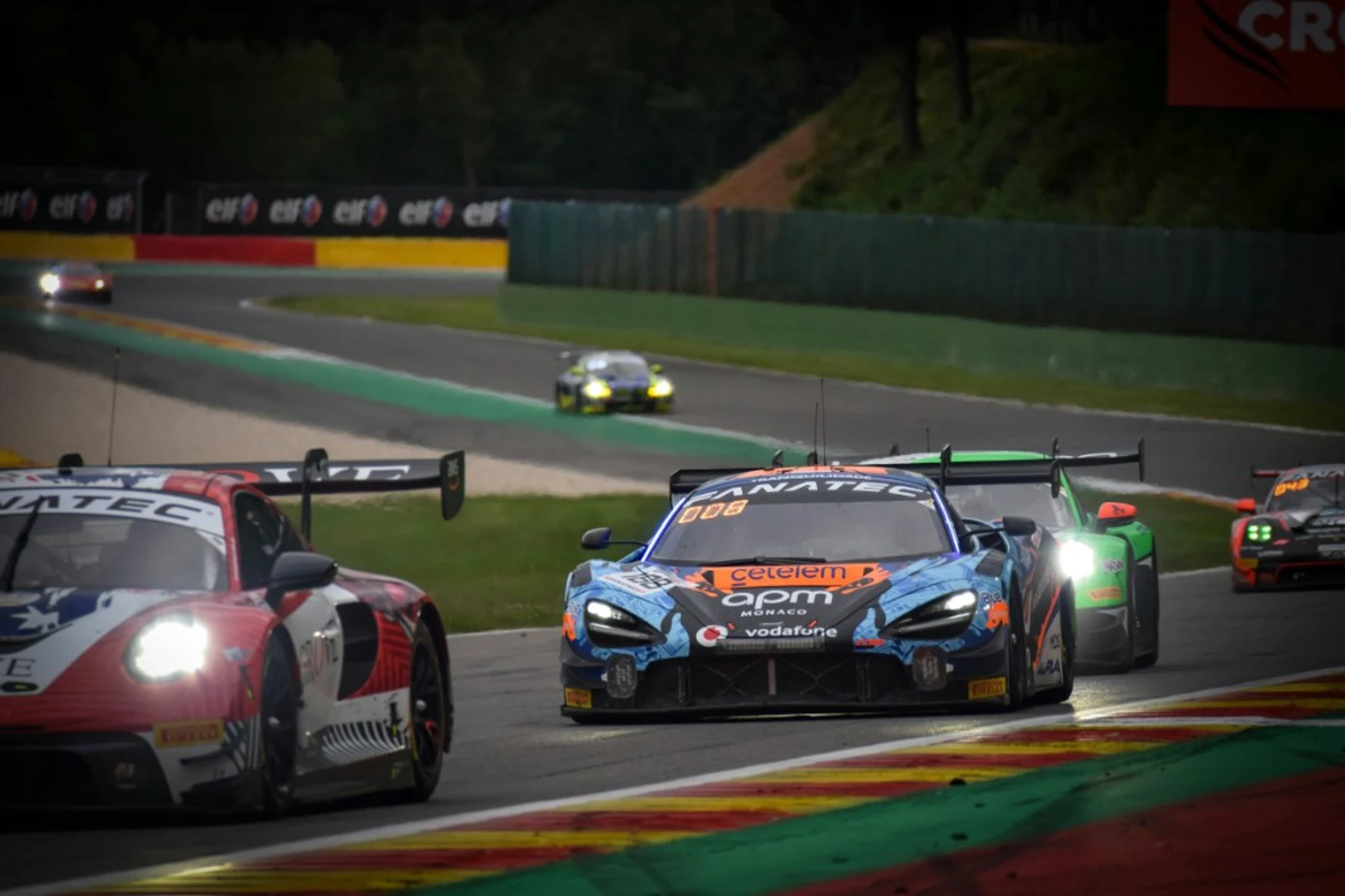
Photo by Benoit Fraikin on Unsplash

Mission brief

Trackside pressure, public engineering.

We embedded with the team for 48 hours at Spa—identifying friction as it happened and shipping working software while the race was still running.

The story Field report

We went to a race to find out what useful AI looks like in the real world.

The 24 Hours of Spa is not a controlled environment. It is a moving target: race control updates, weather changes, penalties, incidents, fatigue, and a garage making decisions with incomplete information. That made it the right place to test a simple question: can modern engineering turn context into useful capability quickly enough to matter?

We started by listening. Working alongside Greystone GT, we mapped the decisions engineers had to make and the information they needed to make them. From there, the work became a tight loop of conversations, prototypes, validation, and refinement. Every feature had to earn its place against live timing data and the reality of the garage. A fast answer is not useful if the team cannot trust its source, understand its assumptions, or access it when the pressure is on.

By race start, the platform was live. As the weekend unfolded, it shifted from race-state tracking to strategy questions, penalty risk, weather, and finish scenarios. The useful result was not a polished demo. It was a shared working tool, grounded in validated data and available to the people making decisions, that changed the conversation from whether agents could help to what they should do next.

Post-race review

Proof under pressure.

We showed up with laptops. We left having completed our first GT World Challenge 24-hour race alongside Greystone GT—no podium, but a platform proven in one of the hardest environments in motorsport.

Follow the full journey

Result

Finished

Greystone GT #44 across the line after 24 hours at Spa.

Platform

Proven

Live race dashboard evolved trackside and earned engineer trust.

Shift

What's next?

The conversation moved from validation to what the agent should do next.

What we learned

  • Building the software wasn't the bottleneck—understanding the problem was.
  • Every metric and prediction had to validate against official race data. Trust beat polish.
  • Agents can carry context overnight, but humans still own judgment under pressure.

Follow the journey

From first conversation to checkered flag.

Start at T-48 and follow seven dispatches through to the finish: the questions we heard, the software we shipped, and what changed along the way.

24 Hours of Code. 24 Hours of Spa.

T-48

24 Hours of Code. 24 Hours of Spa.

Live log open

Live log open T-48

24 Hours of Code. 24 Hours of Spa.

We’re headed to Belgium with nothing but laptops.

Over the next 48 hours, we’ll embed with a GT3 team competing in the CrowdStrike 24 Hours of Spa, learn how they operate under pressure, and see how quickly modern engineering can turn real-world challenges into working solutions.

No roadmap. No demo. Just listening, building, and shipping in one of the toughest environments in motorsport.

We’ll build in public. Stay Tuned.

T-48.

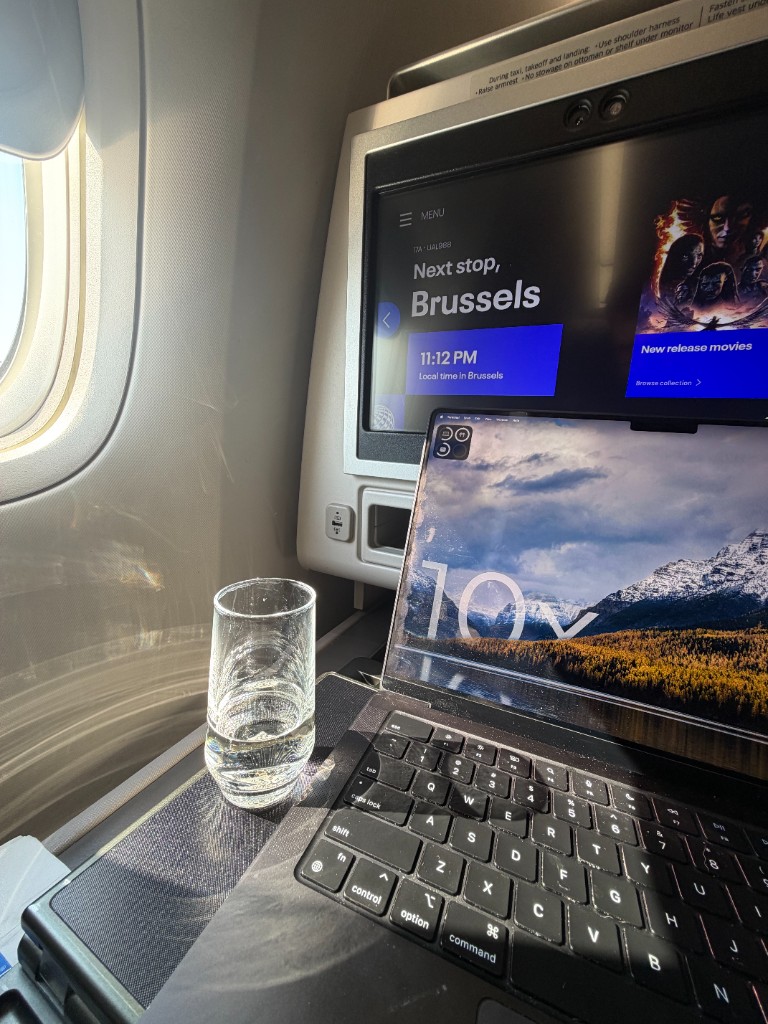
A 10x laptop open on an airplane tray table with the seatback screen showing next stop Brussels.
En route to Brussels. Laptop open before wheels down.
Open LinkedIn post
Trackside.

T-36

Trackside.

Trackside

Trackside T-36

Trackside.

We’re in Spa.

We arrived in the garage as McLaren Trophy Race 1 was underway, with all four Greystone GT cars on track and the GT3 paddock coming to life.

The first job wasn’t writing code. It was understanding how the team works.

We started by building a knowledge base from the official regulations, schedules, and race-week context. Then we sat down with the people making the decisions, listened for where the friction lives, and started asking questions.

From that first conversation, Ryan generated a proof-of-concept race dashboard tailored to the team’s workflow. Not because we planned it. Because that’s where the problem led us.

This is our loop for the weekend: Listen → Understand → Build → Test → Repeat.

The race hasn’t started. The build has.

T-36.

Trackside at Spa-Francorchamps. The build starts here.
Open LinkedIn post
Race Day. T-4 Hours.

T-4

Race Day. T-4 Hours.

Race day

Race day T-4

Race Day. T-4 Hours.

Race Day. T-4 Hours.

In four hours, the green flag drops on the CrowdStrike 24 Hours of Spa.

Yesterday was about understanding.

Today is about execution.

One of the most interesting moments happened while we weren't here.

Before leaving the garage last night, we handed the platform a roadmap of work and let the agents continue building unattended. This morning, we walked back into the garage to find a fully assembled platform waiting for us—new capabilities implemented, interfaces refined, documentation generated, and ready for review.

That changes the way engineering feels.

Instead of spending the morning recreating context or assigning work, we spent it evaluating, refining, and integrating. The bottleneck wasn't writing software—it was deciding what should happen next.

We're now connecting the platform to live race data, transforming it from a planning tool into something that can understand what's happening as the race unfolds.

One theme has become increasingly clear throughout the weekend:

The challenge isn't collecting more information. It's recognizing when the assumptions behind the current plan have changed.

Track conditions evolve. Regulations come into play. Race control issues new instructions. A yellow flag changes strategy. A safety car changes everything.

The interface shouldn't simply display data - it should understand the context, surface what matters, and make changes impossible to miss when cognitive load is already at its highest.

Every conversation with the engineers has pushed us closer to that vision.

This weekend has become more than building software for a race team. It's become an experiment in what engineering looks like when agents can carry context, work continuously, and allow humans to focus on judgment instead of coordination.

The race starts in four hours.

The platform is ready.

Now we find out how it performs under pressure.

Pit lane on race morning. Four hours to green flag.
Open LinkedIn post
The race is on!

+0H

The race is on!

Live

Live LIVEShipped+0H

The race is on!

The race is on!

39°C in the garage. Lap one was chaos, but Greystone GT #44 stayed clean and climbed from P22 to P18.

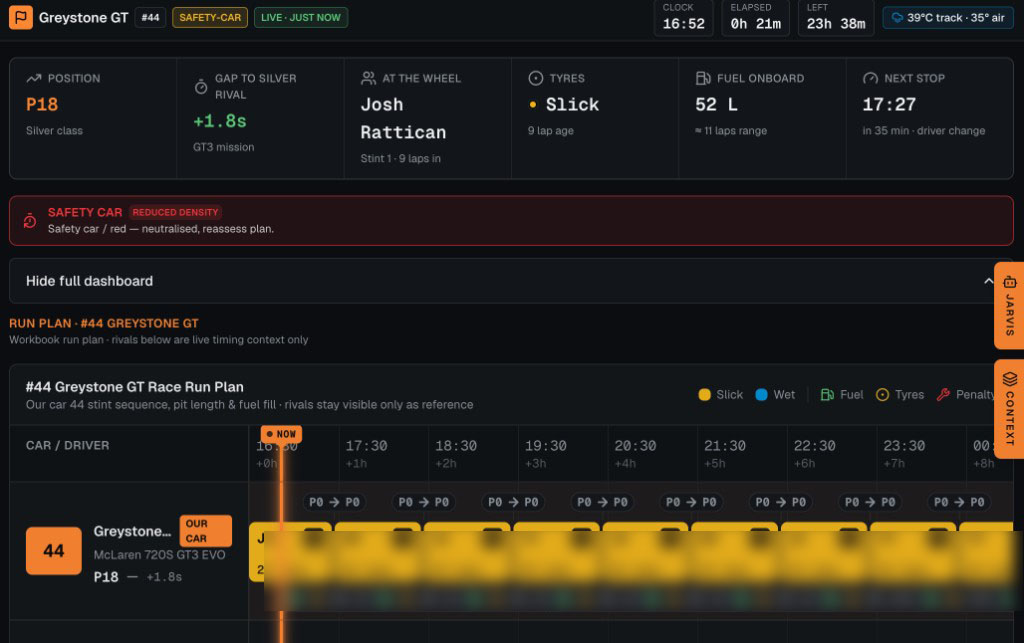
And we made it: the dashboard is now live.

After two days of listening, building, and iterating trackside, it's now connected to the race and supporting the team in real time.

Now we stop building and start learning.

Let's go. 🏁

Greystone GT #44 live race dashboard showing P18, safety car alert, stint plan, and real-time telemetry.
The dashboard is live. Connected to the race, supporting the team in real time.
Open LinkedIn post
7 Hours In.

+7H

7 Hours In.

On track

On track +7HUpdateLIVE

7 Hours In.

The first seven hours have reminded us why endurance racing is such a compelling proving ground.

Nothing stays static.

A major incident saw an Aston Martin crash directly in front of us, with a wheel striking the front of our car. The team reacted immediately, brought #44 into the pits, replaced the front bumper, and got the car back out to continue the race.

While the team keeps adapting on track, we've been doing the same in the garage.

The dashboard has continued to evolve throughout the race. Every feature has come directly from engineer feedback, tested under real race conditions, then refined.

So far we've:

  • Improved race-state tracking and prediction accuracy
  • Added continuous validation against official race timing and published data
  • Integrated weather forecasting for overnight strategy
  • Started tracking track limits and penalties across the field
  • Begun building finish predictions and scenario planning as conditions change

One thing has become clear over the last two days: building the software isn't the hard part anymore.

Understanding the problem is.

The most encouraging feedback hasn't been about a specific feature—it's that the engineers are already asking, "What's next?"

That's exactly what we came here to test.

The race is still unfolding.

So is the platform.

🏁 17 hours to go.

Seven hours in. Race state on the dash, platform evolving in the garage.
Open LinkedIn post
18 Hours In.

+18H

18 Hours In.

Garage open

Garage open +18HUpdateLIVE

18 Hours In.

Six hours of sleep. Back in the garage.

Overnight, Greystone lost both boost controllers, spending 1 hour and 3 minutes in the pits. That effectively ended any hopes of a competitive finish, but not the race itself.

As the race changed, so did the questions.

The focus has shifted from executing our own strategy to understanding everyone else's. The team now wants to know where we'll realistically finish based on penalties across the field, which teams are carrying risk, and whether competitors are holding their fastest drivers in reserve for the final push.

The agent can already answer those questions.

Now we're turning those answers into visualizations that engineers can understand at a glance, because when the garage is under pressure, speed of understanding matters as much as speed of analysis.

One of the best lines of the weekend actually came from the agent itself:

"That is how dashboards become hallucination machines with CSS."

It was talking about why we've spent so much time validating every metric and prediction against the official race data. A beautiful dashboard is worthless if the underlying information can't be trusted.

Our work has shifted too. The focus now is code review, performance, reliability, and making sure everything we've built this weekend is repeatable for the next race.

The race changed.

So did the software.

Back at the track. The race changed overnight — so did the software.
Open LinkedIn post
Checkered Flag.

+24H

Checkered Flag.

Checkered flag

Checkered flag +24HFinishedShipped

Checkered Flag.

Twenty-four hours ago, we showed up at Spa with nothing but laptops.

Today, we leave having completed our first GT World Challenge 24-hour race alongside Greystone GT.

It was also the first 24-hour race for all four drivers.

We didn't come away with a podium, but we came away with something just as valuable: proof.

The dashboard evolved throughout the weekend into a trusted part of the workflow. More importantly, the race engineers found the agent genuinely useful. As they used it, the conversation shifted from "Can this help?" to "What should we have it do next?"

That's exactly what we hoped to learn.

Over the course of the weekend, we built, tested, validated, and refined in real time—turning conversations in the garage into working software while the race was still running.

The biggest lesson?

The technology is ready. The challenge isn't building agents anymore—it's giving them the right context, guidance, and trust to solve real problems.

Not a podium this time.

But a solid finish, a platform proven under pressure, and a lot of excitement for the next event.

On to the next race. 🏁
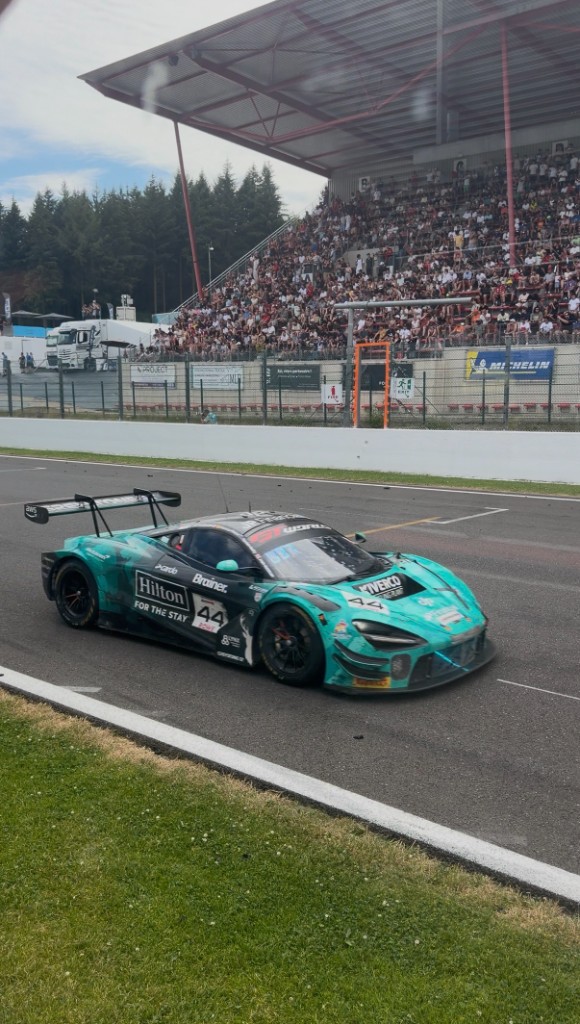
Greystone GT #44 McLaren crossing the finish at Spa-Francorchamps after the CrowdStrike 24 Hours of Spa.
Checkered flag. #44 across the line.
Open LinkedIn post

What's next

Spa is done. The builds continue.

Follow 10x on LinkedIn for the next project—more public engineering, more real-world pressure, and more of what we learned trackside put to work.

Follow 10x